
The Big Ditch – Winter 2026
Onto a New Season!
By Davia Webb, Reference Librarian
2026 is here!
We hope you have your New Year’s Resolutions ready. The New Year means new goals, new hobbies, and new experiences. It also means a new basketball season!
Interested in some of the old school ballers? Check out this yearbook photo of the 1960s girls’ basketball team from Central High School.
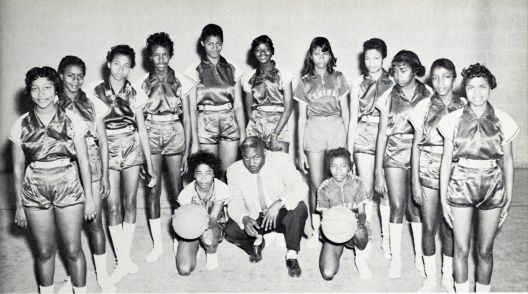
FIRST ROW: Janice Coley, Lillian Hamilton, Bettie Suggs, Sarah Atkinson, W. Jones, E. Best, J. Jackson, S. Swinson, P. Spruill, G. Bowden, M. Smith. KNEELING: Mary Best, Mr. A. C. Murrell (coach), Mable Hamilton.
2026 is here!
We hope you have your New Year’s Resolutions ready. The New Year means new goals, new hobbies, and new experiences. It also means a new basketball season!
Interested in some of the old school ballers? Check out this yearbook photo of the 1960s girls’ basketball team from Central High School.
FIRST ROW: Janice Coley, Lillian Hamilton, Bettie Suggs, Sarah Atkinson, W. Jones, E. Best, J. Jackson, S. Swinson, P. Spruill, G. Bowden, M. Smith. KNEELING: Mary Best, Mr. A. C. Murrell (coach), Mable Hamilton.
That’s Old News!
By Justin Pickett, Reference Librarian
Check out this photo from our General Photograph Collection. Herman Edward Moore, a Western Union clerk, aged 14, stands in front of a wall of snow in downtown Goldsboro in March of 1927. At the time, the storm was considered the biggest of the 20th century!
That’s a lot of snow! Could there be a possibility of this happening again here in Wayne County? We shall see.
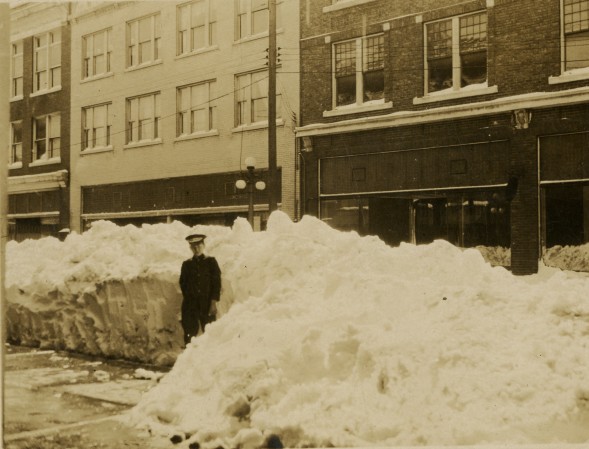
Check out this photo from our General Photograph Collection. Herman Edward Moore, a Western Union clerk, aged 14, stands in front of a wall of snow in downtown Goldsboro in March of 1927. At the time, the storm was considered the biggest of the 20th century!
That’s a lot of snow! Could there be a possibility of this happening again here in Wayne County? We shall see.
It’s a New Year!
By Justin Pickett, Reference Librarian
It’s hard to believe that the New Year has fallen upon us. With the holiday season ending and a brand-new year starting, reminiscing on memories of the year can be bittersweet. New Years postcards are keepsakes that can help remind yourself that a fresh season is coming into your life. Starting in the 19th century as a form of communication, the cards often hold heartfelt and loving connection.
Our Local History Collection includes postcards from over the years that don words of affirmation for a year of happiness, as seen with the card pictured.
Happy New Year and cheers to a new beginning for 2026!

It’s hard to believe that the New Year has fallen upon us. With the holiday season ending and a brand-new year starting, reminiscing on memories of the year can be bittersweet. New Years postcards are keepsakes that can help remind yourself that a fresh season is coming into your life. Starting in the 19th century as a form of communication, the cards often hold heartfelt and loving connection.
Our Local History Collection includes postcards from over the years that don words of affirmation for a year of happiness, as seen with the card pictured.
Happy New Year and cheers to a new beginning for 2026!
Preservation Corner:
Vinegar Syndrome
By Davia Webb, Reference Librarian
Vinegar syndrome: the death sentence of film.
What is it?
Vinegar syndrome refers to the chemical deterioration of cellulose acetate film, characterized by its distinct vinegar smell due to acetic acid. This causes the plastic coating on the film to shrink, become brittle, and break. This can affect sheet film, 35mm negatives, and microfilm.
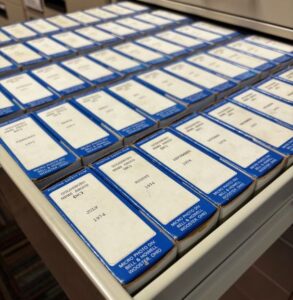
One of our most used resources is our Microfilm Collection, so if you’re ever browsing and you think you notice something out of the ordinary, PLEASE let us know!
Vinegar syndrome: the death sentence of film.
What is it?
Vinegar syndrome refers to the chemical deterioration of cellulose acetate film, characterized by its distinct vinegar smell due to acetic acid. This causes the plastic coating on the film to shrink, become brittle, and break. This can affect sheet film, 35mm negatives, and microfilm.
One of our most used resources is our Microfilm Collection, so if you’re ever browsing and you think you notice something out of the ordinary, PLEASE let us know!

How to prevent it?
Film should always be stored in a cool and dry place. High humidity and high temperatures are the main cause of vinegar syndrome. It is also best to store your film in vented enclosures. Fully sealed storage methods can trap acetic acid and speed up the deterioration process. Once film has vinegar syndrome there is no way to stop it, you can only slow it down.
Freezing the film is the best course of action, but it is often not an option for many people. It is crucial that it is detected early to prevent other film near it from being contaminated. When in doubt, seek professional guidance for next steps.
How to prevent it?
Film should always be stored in a cool and dry place. High humidity and high temperatures are the main cause of vinegar syndrome. It is also best to store your film in vented enclosures. Fully sealed storage methods can trap acetic acid and speed up the deterioration process. Once film has vinegar syndrome there is no way to stop it, you can only slow it down.
Freezing the film is the best course of action, but it is often not an option for many people. It is crucial that it is detected early to prevent other film near it from being contaminated. When in doubt, seek professional guidance for next steps.
How to detect it?
The easiest way to tell is by smelling the film. If you smell salt and vinegar chips, that is your film telling you it’s dying. The vinegar smell usually appears before any visible damage or deterioration to the film itself, especially on rolled film reels.
A-D strips can also be used to detect the deterioration level, indicated by color change after exposure. These strips may be able to detect issues before you are able to smell the vinegar scent. To test your film, place the strip and the film in an enclosed container together and use the chart below to identify the condition of the film.
How to detect it?
The easiest way to tell is by smelling the film. If you smell salt and vinegar chips, that is your film telling you it’s dying. The vinegar smell usually appears before any visible damage or deterioration to the film itself, especially on rolled film reels.
A-D strips can also be used to detect the deterioration level, indicated by color change after exposure. These strips may be able to detect issues before you are able to smell the vinegar scent. To test your film, place the strip and the film in an enclosed container together and use the chart below to identify the condition of the film.
| A-D Strip color | Film Condition |
|---|---|
| 0-blue | Good-no deterioration |
| 1-teal | Fair/Good-deterioration starting |
| 1.5-green | Rapid decay starting-point of autocatalytic decay |
| 2-lime green | Poor-actively degrading |
| 3-yellow | Critical-shrinkage/warping, hazardous |
| A-D Strip color | Film Condition |
|---|---|
| 0-blue | Good-no deterioration |
| 1-teal | Fair/Good-deterioration starting |
| 1.5-green | Rapid decay starting-point of autocatalytic decay |
| 2-lime green | Poor-actively degrading |
| 3-yellow | Critical-shrinkage/warping, hazardous |
Nothing lasts forever, so overtime you may start to notice your own film having issues. Before that happens bring it to the Local History Room so you can digitize your film and ensure you have access to your memories for years to come. If you are new to the process, come join us for our Digitization Workshop happening Tuesday, January 20th at 2:00 PM. You’ll get some hands on practice to digitizing your own photos!
Nothing lasts forever, so overtime you may start to notice your own film having issues. Before that happens bring it to the Local History Room so you can digitize your film and ensure you have access to your memories for years to come. If you are new to the process, come join us for our Digitization Workshop happening Tuesday, January 20th at 2:00 PM. You’ll get some hands on practice to digitizing your own photos!
Wanna See Something Cool?
“To Save the Soul of America”
By Davia Webb, Reference Librarian
Black History Month, a time to commemorate the efforts and contributions of African Americans, is coming up soon! Even though it is the shortest month of the year there is never a shortage of new information to learn about the achievements of the black community. Civil Rights protests happened everywhere including right here in Goldsboro.
Below we have an undated photograph of a Southern Christian Leadership Conference (SCLC) demonstration in Downtown Goldsboro. Led by what seems to be the SCLC president, members of the group carry signs that read “Keep Hope Alive” and “Freedom and Justice for All”. Although the photograph is undated, this event occurred sometime after 1957, which was the founding year of the organization. Led by Martin Luther King, Jr., as the first president, the SCLC was established to organize non-violent protest efforts against racial inequality and segregation. With the motto “To save the soul of America”, the SCLC coordinated demonstrations just like the one seen here all over the country to end segregation everywhere.
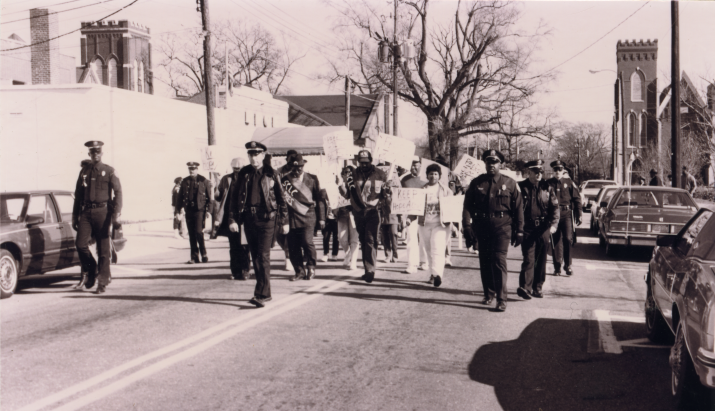
Do you have info about this photo or the SCLC in Wayne County?
We would love to hear from you!